What You Will Learn
- Generative AI applications solve focused business problems with measurable outcomes.
- RAG helps AI apps answer using verified business data.
- Python is widely used for generative AI development because of its AI libraries, frameworks, and model ecosystem.
- Generative AI MVP development costs often start around $25,000 and increase with features, integrations, and complexity.
- Enterprise AI app costs rise with system integrations, security, compliance, and scalability needs.
- Healthcare, legal, finance, retail, and customer support are common areas for Generative AI application adoption.
- Small businesses can start with API-based AI applications before investing in custom enterprise platforms.
- Future AI apps are expected to simulate, reason, and act with stronger business and real-world context.
Generative AI is no longer a future-forward concept. It is live infrastructure that businesses are using to automate operations, reduce costs, and serve customers better. If your team is wondering how to build a generative AI application without wasting months or a six-figure budget going in the wrong direction, this guide gives you the full picture.
From architecture decisions and tech stack selection to realistic AI app development costs and high-ROI enterprise use cases, here is everything you need to move from idea to production.
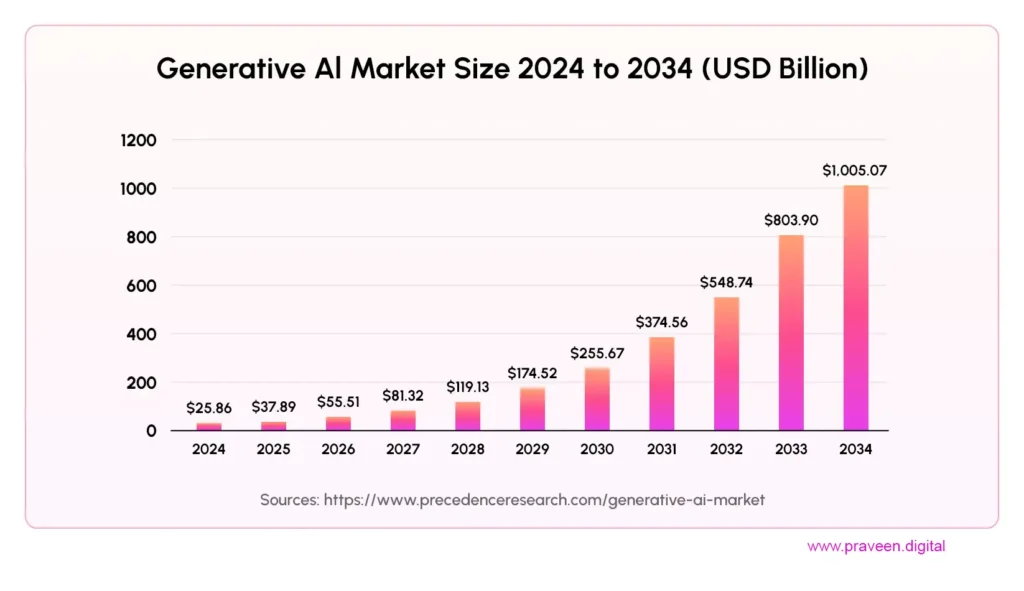
What is a Generative AI Application and How is It Different From Traditional AI?
A generative AI application is software that uses large language models or generative models to create new content, responses, summaries, code, images, audio, or structured data from user inputs. Unlike traditional AI, which usually predicts, classifies, or detects patterns, generative AI produces contextual outputs and can support open-ended tasks.
Traditional AI applications are built for narrow, predefined tasks such as spam detection, fraud scoring, demand forecasting, or image classification. Generative AI applications are built for flexible tasks such as AI copilots, document assistants, content generation tools, chatbot systems, code assistants, and RAG-based knowledge platforms.
| Feature | Traditional AI Application | Generative AI Application |
| Output Type | Predefined categories or predictions | New, contextual content or responses |
| Architecture | Supervised ML models | Foundation models, LLMs, and RAG |
| Flexibility | Task-specific automation | Open-ended reasoning and generation |
| Common Use Cases | Fraud detection, churn prediction, forecasting | AI copilots, document assistants, chatbots |
| Data Handling | Structured data patterns | Structured and unstructured data inputs |
Build Generative AI Apps That Deliver Real Business Outcomes
Turn your AI idea into a scalable application with the right architecture, stack, and roadmap.
What Are the Steps to Create a Generative AI Application?
Building a production-grade generative AI application follows a structured seven-phase process. Skipping key stages, especially discovery, data readiness, architecture planning, or evaluation, is one common reason AI projects fail to move beyond pilot mode.
While a general AI application follows a broader planning and development lifecycle, generative AI apps need additional layers such as prompt engineering, RAG, fine-tuning, vector databases, guardrails, and output evaluation.